The World Cup: A Sociological Perspective
Contributions from Leanne Liu Quach, Filmawit Mekonen, Will Russell, and Jennifer Wheeler
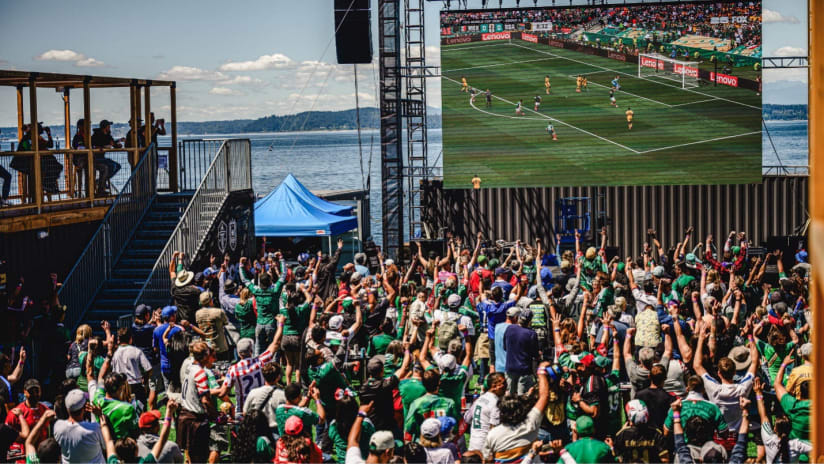
UW Sociology students spent Seattle’s World Cup summer celebrating at watch parties and complaining about the traffic like most Seattleites. For students in Professor Kyle Crowder’s Sociology of Sport class, though, the World Cup was also an opportunity to apply classroom learning to real-world experiences. In spring quarter, SOC 222 students learned how sports reflect and reinforce patterns of stratification by class, gender, race, and ethnicity. The class investigated the ways that broader social, economic, and political debates shape the operation of sports and their role in our daily lives. This summer, students saw concepts they learned in class play out during the World Cup and used sociological theory to understand how the World Cup affected our community. Read some of their reflections on the World Cup through a sociological lens:
Shared Community
Fans from different countries, languages, and cultures gather in stadiums, restaurants, parks and public viewing spaces to celebrate a shared love of the game. These spaces become temporary communities where people who have never met cheer together, exchange stories, and learn about one another’s cultures. From a sociological perspective, these interactions demonstrate how shared experiences can foster a sense of belonging. The World Cup reminds us that community is not only built through long-term relationships, but also through meaningful moments of collective participation.
Social Stratification
Sporting events that facilitate interaction and engagement among communities across the world reveal structural and institutional inequalities that are maintained through subtle and systemic methods. Sociology emphasizes the importance of unifying events as a means to bring people together and to reveal the ways social inequality is upheld at micro and macro levels. We can see social inequality at the World Cup in high ticket prices that prevent many devoted fans from attending matches, making community participation dependent on financial resources. We can understand more about inequality in the context of the World Cup by applying the long history of research on city efforts to sanitize and obscure economic and social inequality from world viewers. By paying attention to city efforts such as moving homeless populations before welcoming international visitors, we can see social issues that need to be addressed. Civic pride events can reveal stratification and provide an opportunity for the public and government to reexamine and align with principles regarding social inequalities. Sociology encourages us to celebrate the excitement of the tournament while also asking who benefits and who is left out.
Collective Effervescence
Famous sociologist Émile Durkheim coined the phrase “collective effervescence” to describe the energy and sense of unity that people feel when participating in intense communal activities. Durkheim focused on religious rituals, but many sociologists have also recognized collective effervescence in the experiences of sports fans. Collective effervescence is that feeling of shared experience that compels you to hug a stranger after a goal, high five a stranger on the train, or sing along to “Country Roads, Take Me Home” after a US win. Collective effervescence strengthens our sense of community and makes us feel connected, serving as an important antidote to the political and economic forces that drive us apart.
Identity and Belonging
The World Cup reminds us that identity is often shaped by more than nationality alone. Many fans support multiple teams because of family heritage, friendships, travel, or cultural connections. Someone might cheer for Team USA while also celebrating the success of the country where their parents or grandparents were born. Others may adopt a favorite team after traveling abroad or forming connections with people from another culture. Sporting events create opportunities to celebrate these layered identities while bringing people together through a shared love of the game.