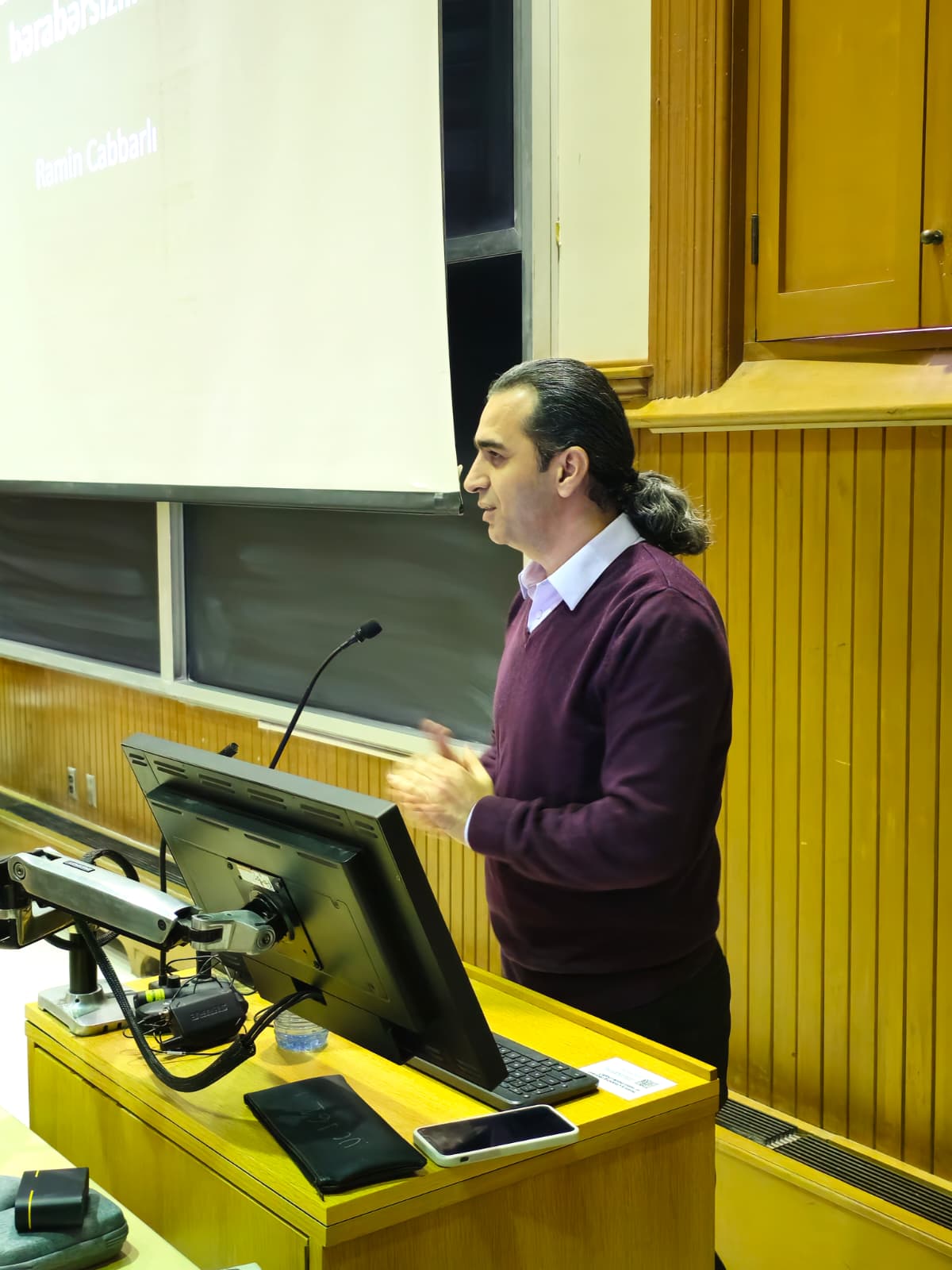
Ramin Jabbarli, a PhD candidate in Sociology at the University of Washington and Director of the Foundation for the Inclusive Society, participated as a panelist in a discussion on language and politics in Iran at the University of Toronto, the Ipek Center organized the event. In his presentation, he examined how language-based inequality and exclusionary linguistic policies have contributed to the systematic underrepresentation of ethnic minorities in Iranian national politics. Drawing on a century-long original dataset he compiled covering the period 1925 to 2024, he analyzed patterns of political representation and compared differences between the dominant Persian ethnic group and the subordinate Azerbaijani Turk ethnic group.
The talk, Mother Tongue in a Changing World, is a timely conversation on language, identity, and the politics of belonging and highlighted how exclusive nation-building projects in Iran, together with Persian-language requirements for public office institutionalized since the early twentieth century, have operated as institutionalized mechanisms of exclusion. These policies restricted access to political participation for non-Persian ethnic groups, including during periods when literacy rates were extremely low and only a small fraction of the population was literate. He showed how language barriers functioned as forms of opportunity hoarding in favor of the dominant Persian ethnic group.
Using evidence from the period beginning with the establishment of the Pahlavi dynasty in 1925 through 2024, he presented trends showing a long-term decline in the political representation of Azerbaijanis and discussed the broader implications for ethnic stratification and institutional inequality in Iran.